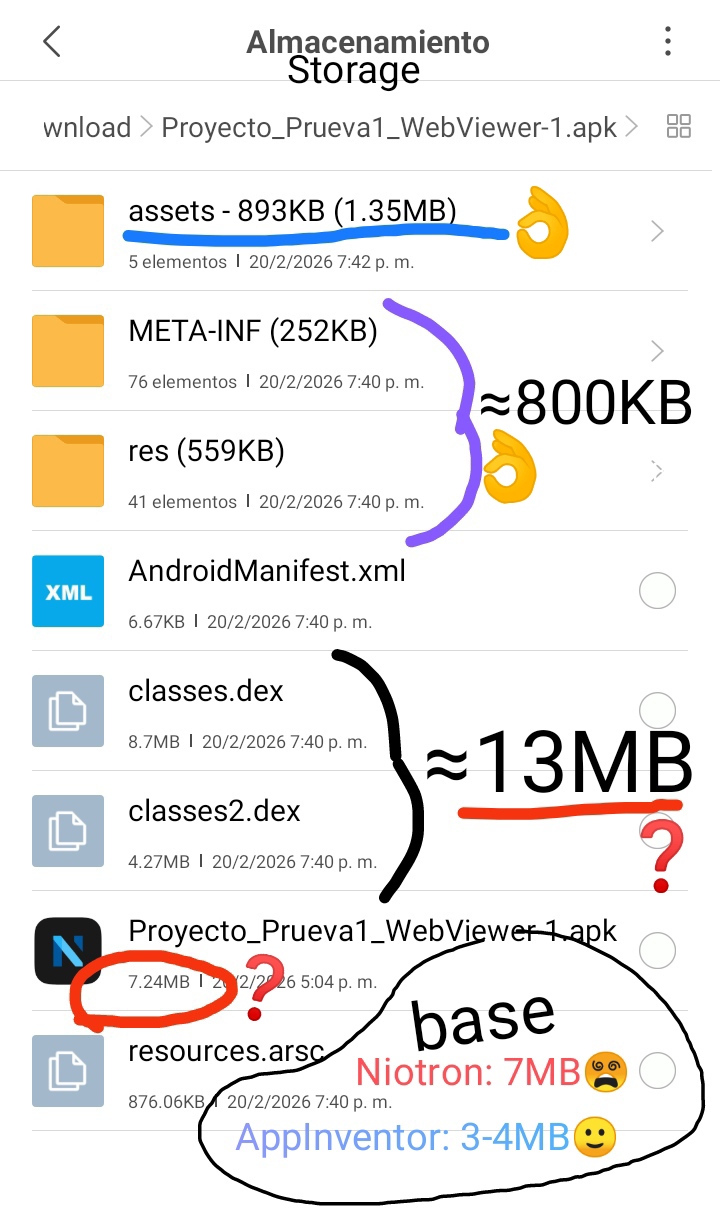
Yes, it’s my case too, generating an APK, because my intension is pure testing, since Companion not allow me login, and it’s ridiculously higher compared with MIT Appinventor results with +3-4MB, developers will have to improve the compiler to eliminate what inneseary and/or what is not used. I use MOBILE DATA and I not have near WiFi services. So this disavowed me a lot too.
Here, a photo, I leave a brief analysis that I did to one of my projects, after open it as apk/zip metod, only +0.24MB by WebViewer+Html/js/css integration.
@Ari_TR I believe this happens because when you export an APK from the Niotron builder, it typically packages native libraries and resources for multiple Android architectures and SDK compatibility targets into a single file. This ensures that the application can run across a wide range of Android devices and versions, but it also increases the overall file size.
In contrast, when you export an AAB (Android App Bundle) and upload it to the Play Store, Google Play dynamically generates and delivers device-specific APKs. It includes only the resources, libraries, and configurations required for the user’s particular device architecture, screen density, and Android version. As a result, the downloaded app is significantly more optimized and usually has a smaller installation size compared to the universal APK generated directly from the Niotron builder.